Check out our AI Agent.Learn more


ROAS vs ROI: What's the Difference?
Both measure return on your marketing investment — but they answer different questions. ROAS tells you how efficiently your ads generate revenue. ROI tells you whether your business is actually profitable.
ROAS vs ROI at a glance
| Characteristic | ROAS | ROI |
|---|---|---|
| Full name | Return on Ad Spend | Return on Investment |
| Formula | Revenue / Ad Spend | (Net Profit − Total Cost) / Total Cost × 100% |
| Measures | Ad efficiency — revenue per ad dollar | Overall profitability — net profit on total investment |
| Costs included | Ad spend only | All costs (COGS, overhead, salaries, ad spend, shipping) |
| Expressed as | Multiplier (e.g., 4.0x) or percentage (400%) | Percentage (e.g., 150%) |
| Best used by | Media buyers, performance marketers | CFOs, business leaders, investors |
| Timeframe | Campaign-level (daily, weekly, monthly) | Business-level (quarterly, annually) |
Full name
Return on Ad Spend
Return on Investment
Formula
Revenue / Ad Spend
(Net Profit − Total Cost) / Total Cost × 100%
Measures
Ad efficiency — revenue per ad dollar
Overall profitability — net profit on total investment
Costs included
Ad spend only
All costs (COGS, overhead, salaries, ad spend, shipping)
Expressed as
Multiplier (e.g., 4.0x) or percentage (400%)
Percentage (e.g., 150%)
Best used by
Media buyers, performance marketers
CFOs, business leaders, investors
Timeframe
Campaign-level (daily, weekly, monthly)
Business-level (quarterly, annually)
Key differences explained
Scope of costs
ROAS only looks at one input: how much you spent on ads. It deliberately ignores COGS, salaries, software, shipping, and every other business expense. This makes it a clean signal for ad optimization — you can compare campaigns, ad sets, and creatives without noise from unrelated costs.
ROI includes everything. It asks: after accounting for all costs of doing business, how much profit did we actually make? A campaign with 4x ROAS might have negative ROI if the product has thin margins and high fulfillment costs.
Actionability for marketers
ROAS is directly actionable. A media buyer can look at ROAS by campaign, kill underperformers, and shift budget to winners — all within the ad platform. It's the primary metric for day-to-day optimization.
ROI requires data from multiple systems (ad platforms, ERP, accounting) and is harder to attribute to specific campaigns. It's better suited for strategic decisions about channel allocation, not daily optimization.
The profitability gap
This is the critical difference: ROAS can be positive while ROI is negative. If you spend $1,000 on ads and generate $3,000 in revenue (3x ROAS), that looks great. But if COGS is $1,500, shipping is $300, and your share of overhead is $400, your total cost is $3,200 — and you lost $200.
Your break-even ROAS bridges this gap. It's the minimum ROAS needed to cover all costs, calculated as 1 / gross margin. With 50% margins, your break-even ROAS is 2.0x. Anything above that is profitable.
Time horizon
ROAS is typically measured in short windows — daily, weekly, or per campaign flight. This makes it responsive but can miss delayed conversions or long purchase cycles.
ROI usually covers longer periods — quarterly or annually — giving a fuller picture of business health but making it harder to trace back to specific marketing actions.
When to focus on ROAS
ROAS is the right metric when you need campaign-level accountability and fast optimization cycles.
- Day-to-day ad campaign optimization — comparing ad sets, creatives, and audiences
- Performance reporting to media teams — tracking ad efficiency over time
- Budget allocation between campaigns — shifting spend to highest-ROAS performers
- Creative testing — measuring which ad variations drive the most revenue per dollar
- Platform comparison — evaluating Meta vs TikTok vs Google on ad efficiency
When to focus on ROI
ROI is the right metric when you need to understand actual business profitability, not just ad efficiency.
- Board and investor reporting — showing overall marketing profitability
- Channel strategy decisions — should we invest more in paid social or expand to new channels?
- Business health assessment — are we actually making money after all costs?
- Budget justification — proving marketing's total contribution to the business
- Long-term planning — evaluating the profitability of marketing programs over time
How Rule1 helps you track both
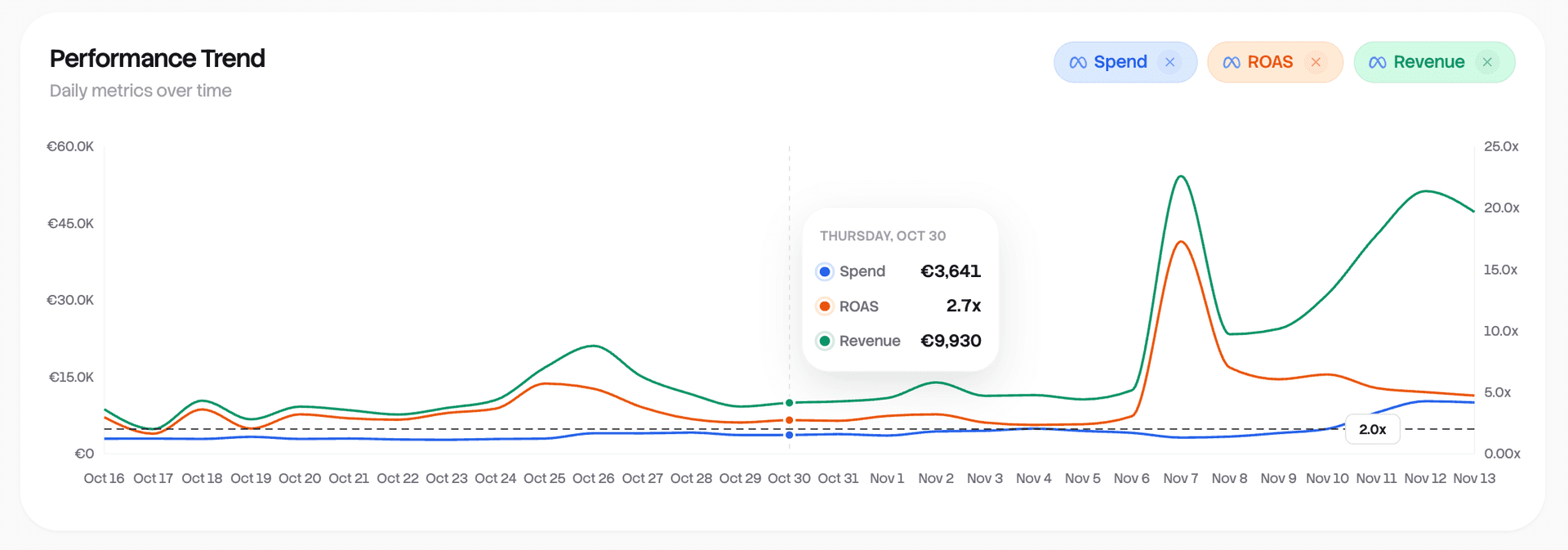
Rule1 tracks ROAS across all your Meta and TikTok campaigns in real-time. AI Creative Reports break down ROAS by creative element — so you know not just which ads perform, but which hooks, CTAs, and messaging angles drive the highest return.
Calculate your break-even ROAS with our free calculator to bridge the gap between ROAS and ROI, then use Rule1 to ensure your creatives consistently beat that threshold.
Frequently asked questions
Related pages
Facebook Ads vs Google Ads: Which Is Better?
CompareSide-by-side comparison with clear examples and data.
Learn morePerformance Marketing vs Brand Marketing
CompareSide-by-side comparison with clear examples and data.
Learn moreROAS Analytics
FeatureROAS meaning explained: Return on Ad Spend formula, benchmarks by industry, and how Rule1 tracks ROAS automatically across Meta and TikTok ad accounts.
Learn moreROAS Calculator
ToolCalculate your return on ad spend instantly with our free tool.
Learn moreRule1 Alternatives
AlternativeSee how Rule1 compares to Motion, Triple Whale, and Madgicx.
Learn moreHow Rule1 helps you track both
Rule1 tracks ROAS across all your Meta and TikTok campaigns in real-time. AI Creative Reports break down ROAS by creative element — so you know not just which ads perform, but which hooks, CTAs, and messaging angles drive the highest return.