Check out our AI Agent.Learn more

Performance Marketing vs Brand Marketing
Performance marketing drives measurable, short-term results — every dollar tracked to a conversion. Brand marketing builds awareness and trust over time — harder to measure but compounds over years. The best brands invest in both.
Performance Marketing vs Brand Marketing at a glance
| Characteristic | Performance Marketing | Brand Marketing |
|---|---|---|
| Primary goal | Immediate conversions (sales, leads, signups) | Long-term awareness, trust, and recall |
| Measurement | Direct — ROAS, CPA, conversion rate, CTR | Indirect — brand recall, NPS, search volume, share of voice |
| Time horizon | Short-term (days to weeks) | Long-term (months to years) |
| Optimization | Continuous A/B testing, real-time bid adjustments | Creative consistency, message repetition, reach |
| Channels | Paid social, search ads, affiliate, email | TV, OOH, sponsorships, content, organic social |
| Creative approach | Direct response — clear CTA, urgency, product-focused | Storytelling — emotional, aspirational, brand-focused |
| Attribution | Clear — trackable clicks and conversions | Fuzzy — hard to attribute individual sales to brand spend |
| Risk profile | Low risk, low ceiling — predictable but plateaus | Higher risk, higher ceiling — compounds over time |
Primary goal
Immediate conversions (sales, leads, signups)
Long-term awareness, trust, and recall
Measurement
Direct — ROAS, CPA, conversion rate, CTR
Indirect — brand recall, NPS, search volume, share of voice
Time horizon
Short-term (days to weeks)
Long-term (months to years)
Optimization
Continuous A/B testing, real-time bid adjustments
Creative consistency, message repetition, reach
Channels
Paid social, search ads, affiliate, email
TV, OOH, sponsorships, content, organic social
Creative approach
Direct response — clear CTA, urgency, product-focused
Storytelling — emotional, aspirational, brand-focused
Attribution
Clear — trackable clicks and conversions
Fuzzy — hard to attribute individual sales to brand spend
Risk profile
Low risk, low ceiling — predictable but plateaus
Higher risk, higher ceiling — compounds over time
Key differences explained
The attribution divide
Performance marketing's biggest advantage is measurability. You spend $1,000 on Meta Ads, track exactly how many purchases result, and calculate ROAS. Every dollar is accounted for. This makes it easy to justify spend and optimize in real-time.
Brand marketing's biggest challenge is that same measurability. When you run a billboard or sponsor a podcast, you can't directly trace individual purchases back to that exposure. This makes brand budgets harder to justify in boardrooms — but it doesn't mean the impact isn't real.
The efficiency plateau
Performance marketing hits diminishing returns. As you scale spend on Meta or Google, you exhaust your most responsive audiences first. CPAs rise, ROAS drops. Every performance marketer has experienced the wall where more spend doesn't mean more results.
This is where brand marketing creates an advantage. Brands with strong awareness have lower CPAs on performance channels because prospects already know and trust them. Brand marketing effectively lowers the cost of performance marketing by creating baseline demand that paid ads can activate.
The Binet & Field research
The most cited research on this topic comes from Les Binet and Peter Field, who analyzed hundreds of IPA Effectiveness cases. Their finding: the optimal long-term split is roughly 60% brand / 40% activation (performance). This ratio maximizes both short-term sales and long-term market share growth.
However, this ratio varies by business stage. Early-stage companies that need immediate revenue often start at 80-90% performance. As they grow and performance channels plateau, shifting toward 50/50 or 60/40 brand-heavy unlocks the next growth phase.
Creative differences
Performance creative is direct: clear value proposition, strong CTA, urgency triggers, product-focused imagery. It's designed to convert immediately. Every element is tested — hooks, thumbnails, CTAs, messaging angles — and data determines what scales.
Brand creative is emotional: storytelling, aspiration, identity, and values. It's designed to be remembered and associated with positive feelings. It doesn't ask for a click — it asks for a place in your mind. The best brand ads make performance ads work harder later.
When to focus on performance marketing
Performance marketing should lead your strategy when you need immediate, measurable results and have clear conversion paths.
- Early-stage brands that need revenue now to survive
- Product launches that need initial traction and proof of concept
- Seasonal or time-sensitive promotions with fixed end dates
- Direct-response ecommerce with clear purchase funnels
- When you have limited budget and need every dollar tracked to a result
When to invest in brand marketing
Brand marketing deserves more budget when performance channels are plateauing and you need to unlock the next growth phase.
- Performance CPAs are rising despite creative optimization
- You've saturated your core audiences on paid channels
- Competitors are outspending you on the same performance channels
- You're entering new markets where nobody knows your brand
- Long purchase cycles where buyers research for weeks before converting
How Rule1 helps optimize performance creative
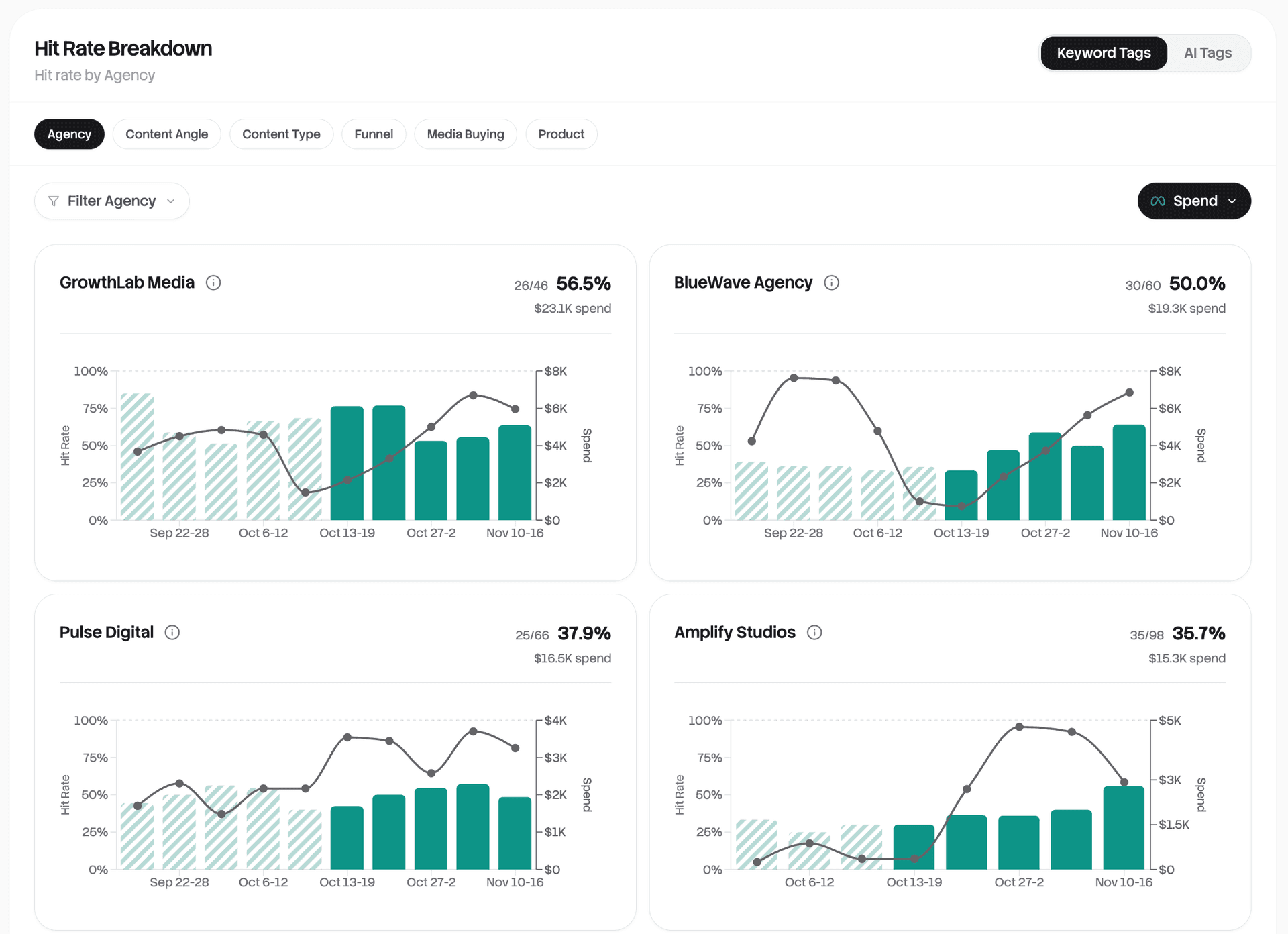
Rule1 is built for the performance marketing side of the equation. Track which creative elements — hooks, messaging angles, CTAs, visual formats — drive the highest ROAS across your Meta and TikTok campaigns. AI Creative Reports analyze 20 dimensions to identify winning patterns.
When performance and brand creative intersect (brand-awareness ads that also drive conversions), Rule1 helps you understand which brand elements actually contribute to performance metrics — turning brand spend into measurable insights.
Frequently asked questions
Related pages
Facebook Ads vs Google Ads: Which Is Better?
CompareSide-by-side comparison with clear examples and data.
Learn moreROAS vs ROI: What's the Difference?
CompareSide-by-side comparison with clear examples and data.
Learn moreROAS Calculator
ToolCalculate your return on ad spend instantly with our free tool.
Learn moreRule1 Alternatives
AlternativeSee how Rule1 compares to Motion, Triple Whale, and Madgicx.
Learn moreHow Rule1 helps optimize performance creative
Rule1 is built for the performance marketing side of the equation. Track which creative elements — hooks, messaging angles, CTAs, visual formats — drive the highest ROAS across your Meta and TikTok campaigns. AI Creative Reports analyze 20 dimensions to identify winning patterns.