Check out our AI Agent.Learn more

AI Tagging: The End of Your Guesswork
Rule1's AI Creative Tagging automatically analyzes every ad creative, tagging hooks, formats, and messaging so you know exactly what drives performance.
You're staring at your top-performing ad. It's crushing it with 3.5x ROAS, scaling beautifully. But when your creative team asks what to make next, you're stuck. What actually makes it work? The hook? The format? The messaging? You'd have to watch it frame by frame, compare it to fifty other ads, and somehow turn gut feelings into a creative brief.
Now multiply that by hundreds of ads across multiple campaigns. It's impossible.
That's why we built AI Creative Tagging.
What if every ad came with a breakdown?
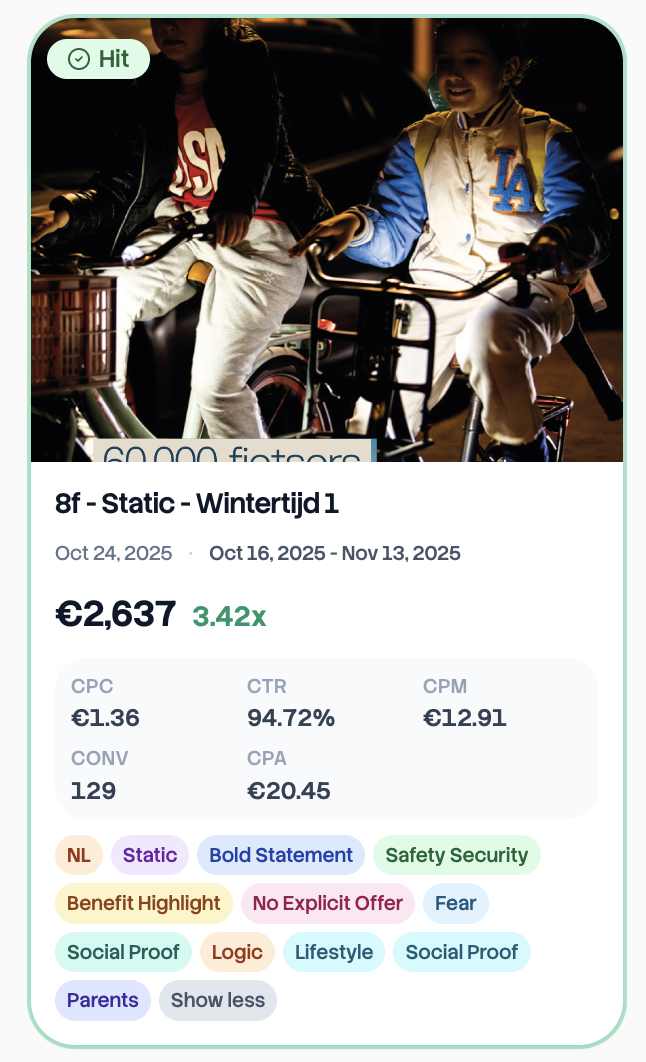
When you sync your ad account to rule1, our AI automatically watches every video and analyzes every image. No manual work. No spreadsheets. Within minutes, each creative gets tagged with a detailed breakdown of what makes it tick.
Think of it as having a creative strategist who never sleeps, analyzing your entire ad library and telling you exactly what patterns drive performance.
The patterns hiding in plain sight
Our AI looks at each creative across multiple dimensions:
Production style. Is it raw UGC shot on a phone? Polished creator content? High-end studio production? Or a hybrid mixing authentic footage with professional editing?
Visual format. Testimonial, product demo, problem-solution, unboxing, talking head, before-after, lifestyle, tutorial, comparison, or skit?
Hook tactic. What stops the scroll in the first three seconds and drives your hook rate? Pattern interrupt, negative hook ("Stop doing this..."), curiosity gap, direct callout, question opener, bold statement, or social proof lead?
Messaging angle. What core value does the ad communicate? Cost savings, time savings, quality, ease of use, health, transformation, status, or security?
Psychological triggers. What's driving action at each stage? The AI identifies the levers being pulled in the hook, body, and CTA.
This isn't just metadata. It's the vocabulary your creative strategy has been missing.
From "I think" to "I know"
Here's what changes when every ad is tagged:
Your top 10 ads all use Curiosity Gap hooks. You didn't realize it because they looked different on the surface. Different creators, different products, different scripts. But the AI spotted the pattern. Now your next brief specifically requests that hook style.
UGC outperforms Studio by 2.3x ROAS. Your team's been pushing for higher production value, but the data says authentic beats polished for your audience. That's a $50k/quarter decision backed by evidence, not opinion. (Need to quantify the difference? Use our ROAS Calculator to see the revenue impact.)
Problem-Solution format has the highest hit rate. Testimonials feel right, but the numbers say otherwise. Time to shift the mix.
These insights were always there, buried in your ad account. The AI just surfaces them.
Built into your workflow
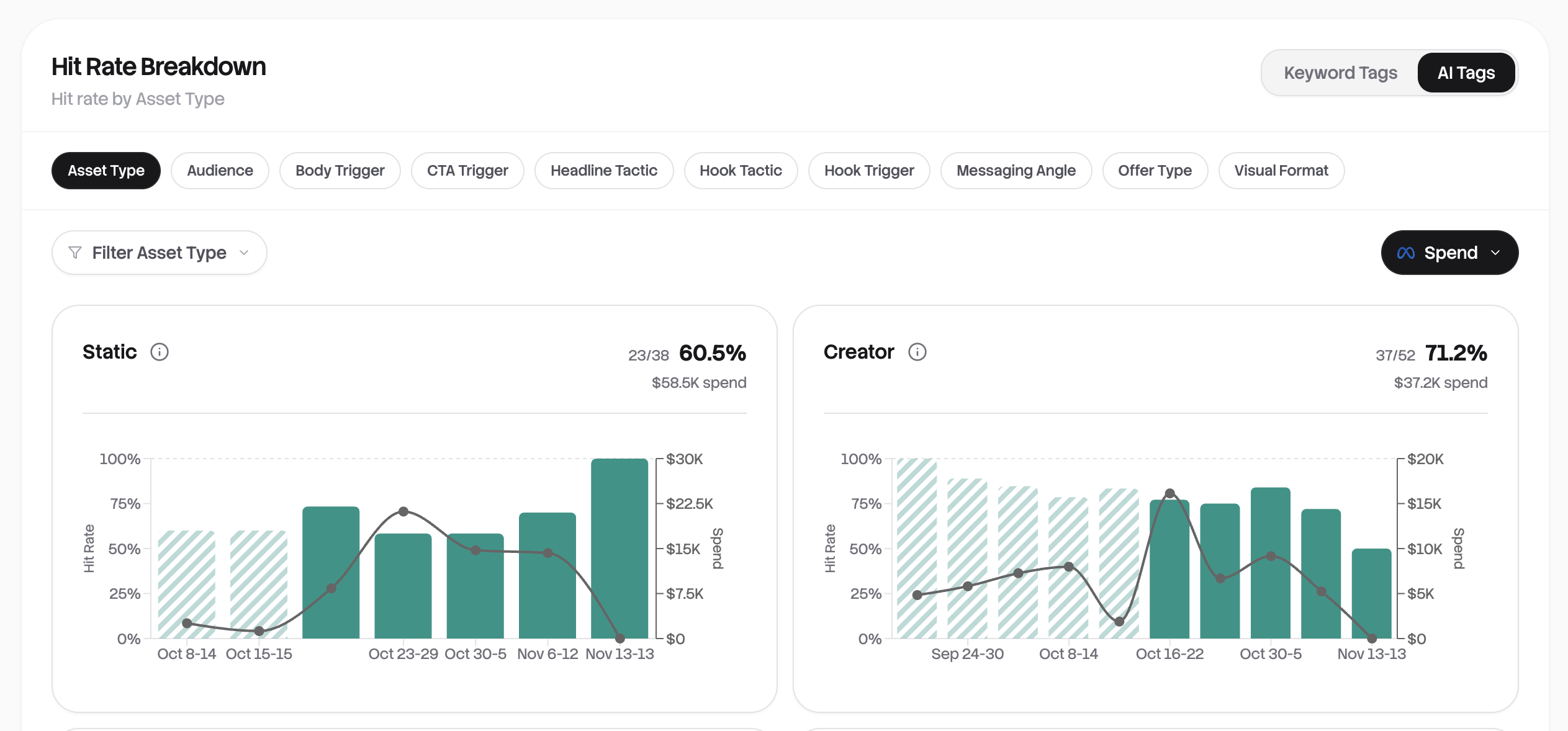
AI tags aren't a separate tool. They're woven into everything you already do in rule1.
On your Dashboard Overview, toggle to AI Tags in the Hit Rate Breakdown to see performance by any dimension. Which hook tactics have the best hit rate? Which production styles are worth the investment?
In the Ads Table, add AI tag columns and sort by any value. Filter to show only "UGC + Negative Hook" ads. Find every testimonial-style creative in seconds.
When you're briefing creatives, you finally have specific language: "We need three UGC videos using Curiosity Gap hooks with a Transformation messaging angle. That combo is hitting 3.2x ROAS for us."
AI Tags vs. Keyword Tags
You might already use Keyword Tags to organize ads by agency, product, or campaign based on naming conventions. AI Tags do something different.
Keyword Tags tell you who made it and what it's for. AI Tags tell you how it's made and why it might work.
Use both together. Filter by Agency X's ads, then see which creative approaches are working for them. Compare Product A's testimonials against Product B's demos. The combination is where the real insights live.
How it works behind the scenes
When your ads sync, our AI downloads every creative, both video and image. Each one gets analyzed using advanced multimodal AI that can understand visual elements, audio, spoken words, and on-screen text together.
The analysis extracts structured tags across all dimensions, then connects those tags to your performance data. The whole process runs in the background. Videos are typically analyzed within minutes. This is one application of a broader shift toward AI-powered ad creative workflows that handle everything from generation to analysis.
You don't configure anything. You don't train anything. You just connect your ad account and the intelligence appears. Wondering how rule1's AI creative analysis compares to other tools? See our comparisons of rule1 vs Motion and rule1 vs Triple Whale.
Creative Reports: Your On-Demand Performance Analysis
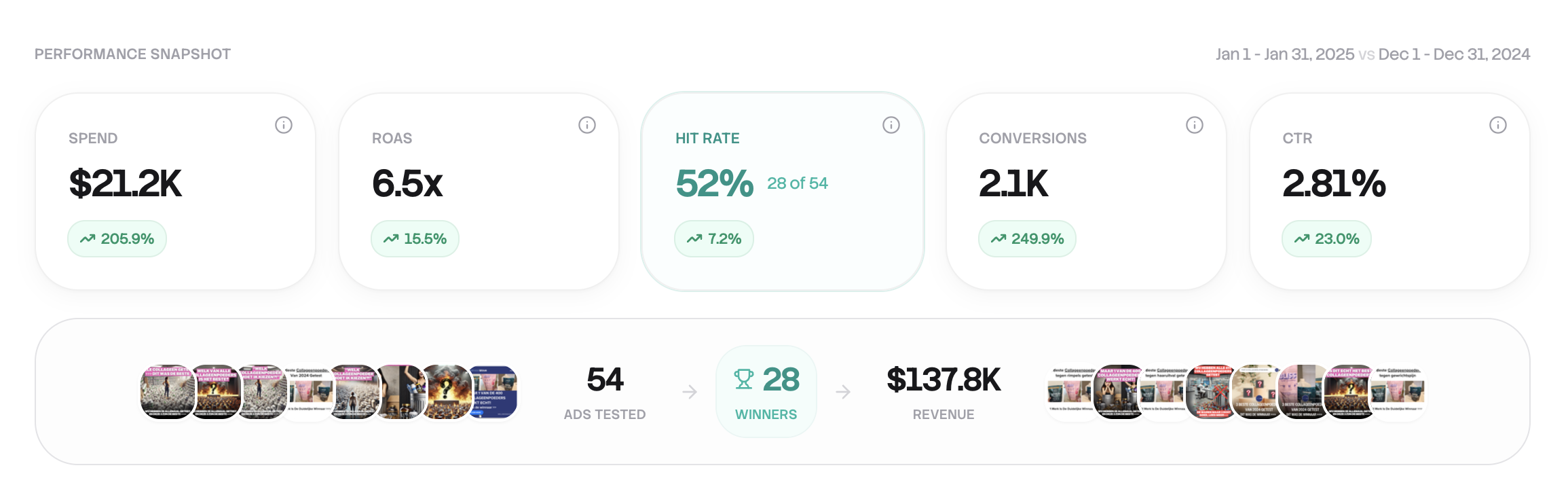
AI tagging gives you the building blocks. But sometimes you need the complete picture: a comprehensive analysis of what's working, what's failing, and what to do next. That's where Creative Reports come in.
Your winning formula, revealed
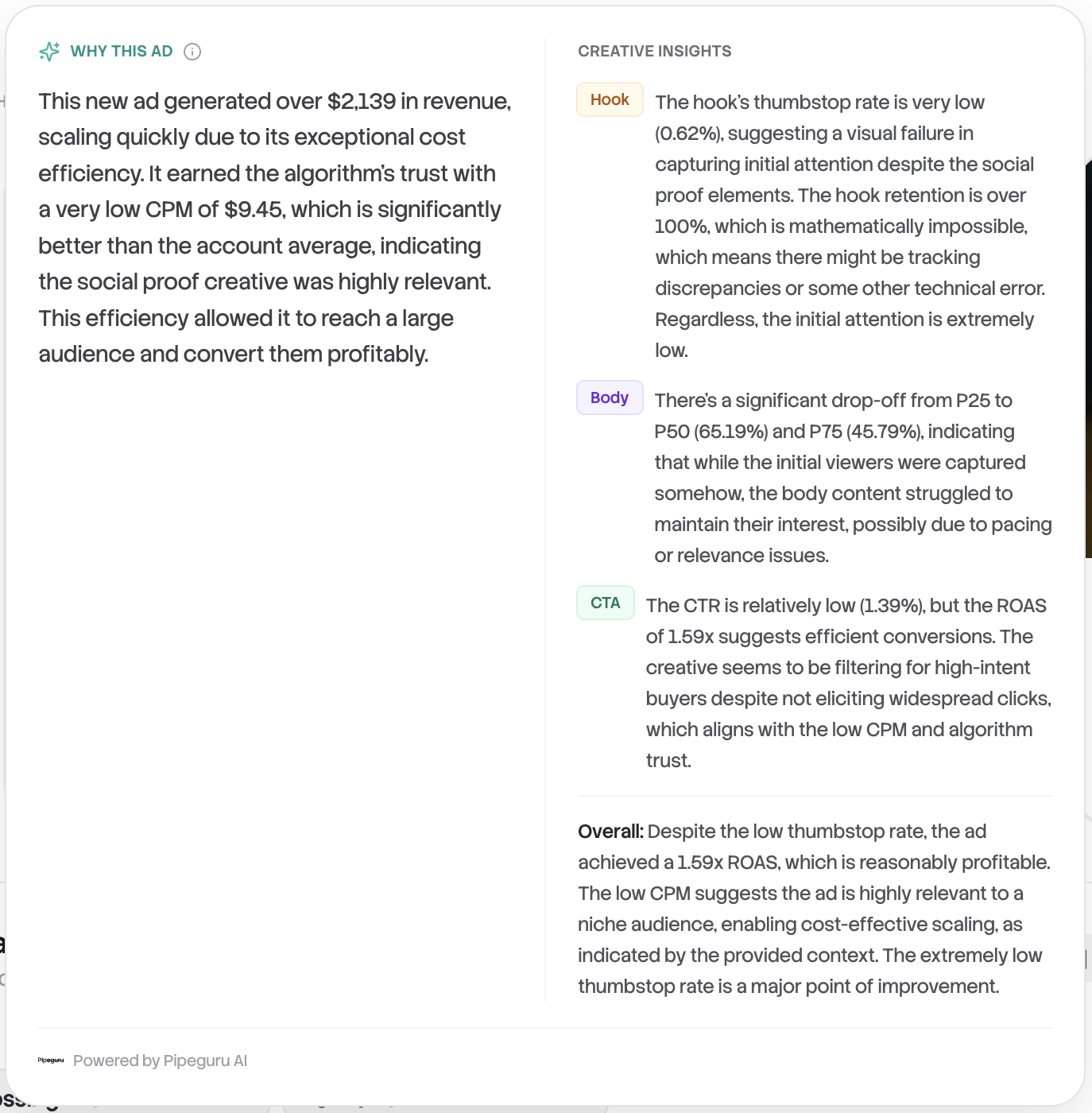
When you look at your top 6 ads individually, they might seem random. Different products, different creators, different campaigns. A Creative Report reveals what they share.
The AI analyzes every ad in the period, then looks across your top performers to find the common threads. "4 of 6 winners use UGC-style production." "5 of 6 lead with a Curiosity Gap hook." "All 6 feature a Transformation messaging angle."
That's not coincidence. That's your winning formula, extracted from your own data.
Reports also show the other end of the spectrum. Your weakest ads get the same analysis, surfacing patterns you should avoid. Maybe your studio-produced content looks beautiful but consistently underperforms. Maybe certain hook tactics fall flat. The report tells you what to cut so you can double down on what works.
Hypotheses, not commands
Creative Reports are designed to be honest. They don't pretend to have all the answers.
When the AI identifies a pattern, it frames it as a hypothesis worth feeding into your creative testing process. When sample sizes are small, it says so. When correlation doesn't prove causation, it acknowledges that. The goal isn't to replace your judgment. It's to give you better inputs for your decisions.
Generate reports regularly and you'll build a history of your creative performance. Last month, testimonials were your winners. This month, product demos are pulling ahead. That trend matters, and sequential reports make it visible.
The complete picture
AI Creative Tagging and Creative Reports work together. Tags give you the vocabulary: every ad categorized across production style, format, hook, and messaging. Reports give you the analysis: patterns, trends, and concrete recommendations based on your actual performance data.
Together, they transform your ad account from a black box into a source of strategic intelligence. Your next winning ad isn't a mystery. It's a formula waiting to be discovered.
Related resources
- rule1 vs Motion — See how rule1's AI tagging compares to Motion's creative analytics
- ROAS vs ROI — Understand the metrics behind your creative performance data
- AI Marketing Tools — The full landscape of AI tools for advertising, analytics, and creative production
Ready to get started?
See how rule1 can transform your ad analytics and help you find winners faster.